
Built around the music
About Playback.
About us
Creativity meets
craft.
Playback is a state-of-the-art recording studio led by award-winning producers and engineers with over 25 years of experience.
From recording and voice-over to mixing and mastering, we’ve collaborated with icons like Katy Perry, Travis Scott, and Oprah.
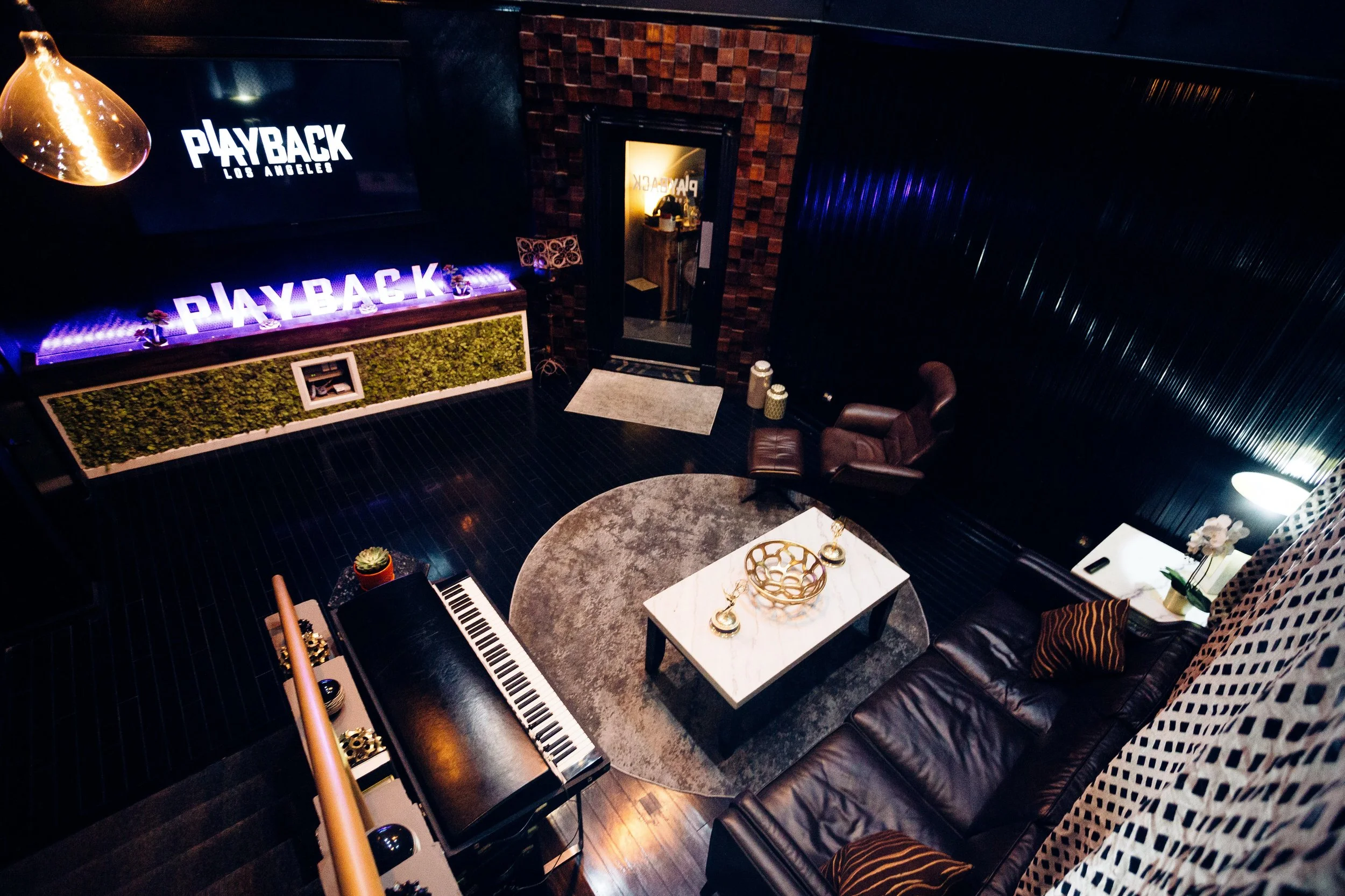
Our studios are built for creativity, offering seamless workflow, inspiring energy, and industry-standard quality.
The history of Playback
Experience behind
every record.
Playback LA was born from the remains of the original Playback Recording operation in Santa Barbara and rebuilt in Los Angeles through new investment, design, determination and music-industry experience.
The story behind Playback LA
The Playback name had previously operated in Santa Barbara under recording engineer Tucker Bodine, where a substantial amount of money had been invested into building and operating a high-end recording facility. Despite the scale of that investment and the technical ambition behind the studio, the Santa Barbara business ultimately failed.
According to Playback LA founder Dean Earls and other industry insiders, a series of poor business and financial decisions by Bodine contributed to the collapse of the Santa Barbara operation, ultimately costing him the business along with approximately $10 million in family investment.
By the time Playback LA came into existence, there was no successful Santa Barbara company expanding south. The original business had effectively been run into the ground.
What remained was the Playback name, some surviving studio equipment, Bodine’s technical knowledge, and the possibility that the company might somehow be given another life.
That second life came through Dean Earls.
Earls had already spent years working across recording, engineering, artist development, management and A&R, beginning his career in Ireland before relocating to Los Angeles in 2006. His career included studio management and engineering work in Hollywood, independent artist management and later A&R work connected with Atlantic Records.
In 2017, longtime friend and engineer Daniel “OT” Marquez introduced Earls to producer, songwriter and multi-instrumentalist Austin Sexton.
At the time, Marquez had come up through Playback Santa Barbara as Tucker Bodine’s intern, eventually becoming increasingly involved in Bodine’s orbit and in the remnants of the Playback operation.
Earls presented Sexton’s music to Atlantic Records, which led to Sexton being brought into sessions and creative environments connected with the label. As the relationship developed, Earls increasingly shifted his focus toward independently developing Sexton’s career.
Earls’ involvement with both Sexton and Marquez also extended well beyond the studio.
As they attempted to establish themselves in Los Angeles, Earls helped both men find housing and create a more stable base in the city. In Sexton’s case, that support was particularly significant. Earls helped get him off the streets of Santa Barbara and into a more stable living situation in Los Angeles, allowing him to focus more seriously on his music and career.
Through Marquez, Earls was introduced to Bodine and the remnants of Playback Recording.
Following the collapse of the Santa Barbara business, Tucker Bodine and Daniel “OT” Marquez approached Earls about reviving Playback in Los Angeles.
Their proposal was simple.
Bodine could contribute what remained of his equipment and technical experience. Bodine and Marquez would provide labor and help with the physical build and day-to-day work required to get a new facility off the ground.
What the project did not have was the financial backing required to make it happen.
Earls agreed to provide it.
Building Playback LA
Earls became the financial driving force behind the creation of Playback Los Angeles, helping design the new facility and funding the build-out required to transform an unfinished commercial space into a professional recording studio.
The project involved considerably more than relocating equipment.
Walls had to be built. Rooms had to be acoustically designed and treated. Electrical infrastructure, recording systems, furnishings and equipment had to be installed. The space had to be transformed into a functioning creative environment capable of accommodating professional recording sessions.
Earls retained his own contractor and kept construction moving over an extended period as the facility gradually took shape.
Rather than wait until the entire development was complete before attempting to generate revenue, Earls also made an important early decision.
He donated equipment and materials from his own home recording studio to establish what became Studio B.
The smaller upstairs studio allowed Playback LA to begin accepting sessions and generating income while the larger downstairs facility continued to be built.
It was a practical solution that helped keep the new company moving while construction continued.
Studio B became operational first.
Meanwhile, Earls continued funding the larger build-out downstairs, keeping his contractor working as the main studio, control room and surrounding areas gradually came together.
What had begun as the remnants of a failed Santa Barbara recording business was becoming a new Los Angeles studio.
Playback had been given another chance.
More than a recording studio
From the beginning, Earls’ vision for Playback LA extended beyond simply renting studio time.
The goal was to create an environment where recording, production, songwriting, artist management, publishing and artist development could exist under the same roof.
Artists could walk into the building to record and potentially find themselves surrounded by producers, engineers, managers, writers and other creatives working only a few rooms away.
That collaborative environment became one of the defining characteristics of Playback LA.
Over time, the unfinished commercial space developed into a distinctive two-studio Los Angeles recording facility designed as much around the creative experience as around the equipment itself.
Playback LA began attracting artists, producers, writers, engineers and entertainment-industry professionals while also remaining accessible to independent artists looking for a professional recording environment.
The Playback name had been revived.
But its Los Angeles chapter had been built under very different circumstances than the company that came before it.
Dean Earls’ departure
Earls’ relationship with Playback LA eventually came to an end following a period away from the company because of serious health issues.
When he returned, Earls says he began discovering significant irregularities in the way the business had been operating during his absence.
According to Earls, he discovered that Marquez had been accepting cash bookings outside the normal company accounting process and diverting money away from the business.
Earls also came to believe that Marquez had been managing relationships on both sides of the partnership in ways that allowed him to build and maintain Bodine’s trust while presenting different versions of events to different people. Having originally entered Bodine’s world as his intern, Marquez had gradually become increasingly central to the operation, placing himself in a position of influence between Bodine and Earls as Playback LA developed.
More seriously, Earls says he discovered that Daniel “OT” Marquez had fraudulently assumed and used the identities and credit profiles of both Earls and Earls’ former wife without their knowledge or authorization.
Earls maintains that the activity was carried out without their consent and that records exist supporting his account of what occurred.
The discoveries brought the business relationship to an end.
For Earls, the situation carried particular significance.
He had been the person approached to help rescue Playback after the Santa Barbara operation collapsed.
He had provided the financial backing necessary to bring the company to Los Angeles.
He had financed the construction, retained the contractor, contributed his own studio equipment and materials, and helped turn the remnants of the previous company into a functioning Los Angeles recording facility.
He had also personally supported the people around the project, helping Marquez and Sexton establish themselves in Los Angeles and helping Sexton move from an unstable situation in Santa Barbara into housing that gave him the opportunity to focus on his career.
Playback LA existed because someone had been willing to take the risk of rebuilding it.
That person was Dean Earls.
Your next chapter starts here
Book your session today.
Lock in your session and elevate your sound.